Showing posts with label Local Government. Show all posts

Wednesday, July 18, 2018

Updates coming... new developments

Since I started this blog over 10 years ago the state of surveillance, monitoring and application of biometric technology used in schools on our children, the next generation, has increased beyond imagination.  Okay, there may be arguments that his 'improves' their education, enables better educational analysis, reduce admin time/costs, etc... but personally, I've not seen a dramatic increase in the next generations intellectual ability or schools being more affluent because of technology.  Certainly here in the UK we currently have a national funding crisis in education. 

Credit: https://www.pinterest.co.uk
/pin/68539225552401806/
It is a different education that is needed for today's kids.  Access to information is greater to an individual than ever before.  Knowing and retaining information in this age maybe is not a necessity as much as it was.  Moreover how to apply that knowledge in this ever changing society perhaps is a skill children should learn.  Discernment, where one's digital footprint is left and the data left again one's digital identity should also be considered.  How, who and what may be assumed by a children's online activities on the Internet - and within a school network - is a burgeoning area that needs urgent consideration, especially for those it could potentially affect in decades to come. 

With governments, private education tech companies and private companies running schools having access to individual educational data from the age of 2 years old (in the UK) to 19 and beyond gives an enormous potential for profiling.  I could write about this for an age, as these are all points that have been raised with the proliferation of technology in education for the past decade plus.

What to do?  I have been absent somewhat from blogging here as the transfer of biometric technology tested used on children in the UK has now widened into the rest of society.  My concern is when the state uses biometric technology without consent, much as schools did from 2001 - 2013 in the UK.  I set up a sister blog a couple of years ago to keep the two developments of biometric technology, schools / wider society, separate - see my State of Surveillance website.

However, there is now an issue of facial recognition creeping into US and Chinese schools for a variety of reasons.  Here in England and Wales (not Scotland or Northern Ireland) facial recognition is not viably an option for schools with under 18 year olds, as per the consent required under the Protection of Freedoms Act 2012.   The argument for the use of biometrics in schools - whether  fingerprint or facial recognition - is basically unproven, as other, less invasive, less 'valuable', means of identification will suffice.   This is an issue I intend to raise again here.

So, hopefully, (in a rather large nutshell) I've explained my absence and fully intend at least once a week to start again back here.   T'will be nice to get back to it!

Tuesday, April 05, 2011

Freedom Bill

Without wanting to nit-pick points too much and argue with written submissions to the Freedom Bill Committee, I just wish to point out some facts to balance up statements made on the use of biometrics in schools included in some submissions.

The The Association of School and College Leaders (ASCL) have submitted a written submission to the Freedom Bill committee:

ASCL: "It is not clear why schools and further education colleges, respectable and responsible public bodies, are singled out in this chapter. If this data [children's biometrics] could be misused, it is surely more likely to be so by other organisations than these..."

Schools and further education are singled out because there has been, and still is, a parental backlash and worries, as posts to this blog will reveal and I am sure the Leave Them Kids Alone website would back this up too. And because childrens fingerprint biometrics do get stolen, potentially misused, as mentioned by one supplier of biometric systems to schools, details here,

ASCL: "School and college leaders are not aware of the use of this kind of technology causing any problems for any young person, nor of any but very isolated concern about its use amongst parents"

Well... no need to go any further than my previous post on this one, as teachers themselves won't use their biometrics, according to one of the biggest teaching Unions NASUWT, as they consider it "an infringement on their civil liberties". 

The Home Office's advice to the Freedom Bill Committee on children understanding the issues of schools using their biometrics: "The issues around the use of biometric data are particularly subtle and complex, and even more mature children may not be able to fully appreciate them. In other areas such as marriage and making a will children under the age of 18 need parental consent. In our view the issues around the giving of biometric data are similar in that respect."        

Friday, February 18, 2011

Gov does Impact Assessment on parental consent for processing childrens biometrics

Over on the Home Office's website is an Impact Assessment entitled:
"Requirement for schools to seek written parental consent before processing children's biometric data". 

It is good to see a document coming from government raising concerns and offering solutions to the controversial subject of processing children's biometrics without parents consent.

It is, in fact, it is the only document that has ever been issued by our government concerning biometrics in schools, in the 10 years the technology has been in used by children.

The previous 'advice' issued by the now defunct quango Becta was issued without any consultancy, knowledge or research into the subject of biometrics whatsoever, legal, academic or otherwise, etc.  This fact came to light in a Freedom of Information request.  

In contrast the above Home Office document outlines many aspects to be considered when using childrens biometrics without their parents consent.

Wednesday, October 29, 2008

Liverpool councillors sever all ties with biometric technology in schools

This from the Liverpool Echo:

"A meeting of the full council will be asked to express its formal “opposition to the fingerprinting of children by schools” and a ban on any local authority-led promotion of its use save for a criminal investigation.

Picton ward councillor Andrew Makinson who is behind the motion said the £20,000 average cost of installing it could be better spent on school staff.

He said government mishaps with personal information was proof all systems were vulnerable.

Council leader Warren Bradley stressed it had always been down to individual schools to adopt the technology.

He added: “It would be wrong to implement a policy and support something which could potentially be of detriment to the protection of our children.”"

Thursday, March 13, 2008

£25,000 biometric cashless system bought - based on "commonly perceived benefits"

At the end of January Sophie McKeand's child's school told parents they were "introducing a "cashless catering system", where children will pay for their school dinners using either a fingerprint identification system or a pin number". This is in Flintshire, Wales.

Sophie rightly objected "to have such important and sensitive biometric data being taken from children for a matter as trivial as buying lunch is absolutely absurd."

Since then Sophie has been busy finding out, via the Freedom of Information Act, just how much these systems cost (using our tax money), where the funding is coming from, who made the decision to implement such systems, etc. - interesting reading indeed.

Her Freedom of Information questions and answers, for Flintshire County Council, are on the "Biometrics in Schools" forum over on the NO2ID site.

Here are a few questions and answers:

3. What is the FULL, TOTAL AND FINAL cost of this system in Alun School?

A3.The full cost of the system in the Alun School is as follows:

PCS Systems £20,905.00
Software £ 1,062.32
Installation £ 1,162.50
Server £ 283.14
Printer etc. £ 574.00
Writing/Electrics £ 1,162.50

TOTAL £25,149.46 [this is cost for one school]

1. I wish to be provided with ALL cost / benefit analysis that have been completed concerning anything whatsoever to do with implementing these cashless systems in Flintshire schools. Not just for Mold Alun but for all schools in Flintshire as stated in the quote from the first letter from Alun School, above. This includes all equipment, maintenance and IT services.

A1. The Council holds no information regarding a cost/benefit analysis. [What?]
The commonly perceived benefits however, are that..... then follows some drivel about reducing bullying and enabling children to eat before afternoon registration, up take of free meals increased, blah, blah.

So, lets get this right...

...the council spends 25K of our money on a biometric/pin cashless catering system purely based on "commonly perceived benefits" - with no cost/benefit analysis to justify such expenditure?

IMHO this sounds like jawdropping negligence.

Flintshire County Council sound like they've been sold a line. "Commonly perceived benefits" that are backed up with absolutely no academic or government literature, but I guess probably literature from sales persons.

It would seem that the implementation of the systems (that were originally proposed to be run throughout all Flintshire Schools, which would be around £250,000 of taxpayers money) has not been a completely open and transparent process, as reported today:

"Cllr Ray Dodd said he shared some of Miss McKeand's concerns. "I am surprised that this biometric system has been introduced in a school already without any consultation with elected councillors.

The education department said there has been extensive consultation, I have not been able to establish any consultation with county councillors,"

Monday, January 28, 2008

In and out

As Iowa plan to allow biometrics back into schools after their House File 685, the child identification and protection act, was signed into law in May 2005, biometric scanners are being axed in schools in Phoenix, Arizona.

An ill informed Jeff Berger of the state Dept of Education, Iowa, states "This technology is really perfectly safe... information can't be reconverted back into an actual fingerprint", this statement is incorrect but this continual and convenient inaccuracy of truth is obviously backed up by the biometric sales industry:

"That's true", said Ali Pabrai, the chief executive officer of Ecfirst.com, a West Des Moines-based biometrics consulting company."

Their views are not shared by Fred Bellamy, a Phoenix Attorney who specializes in Technology Law or Microsoft's Identity Architect Kim Cameron - (I know who'd I'd rather believe).

Fred Bellamy went on to say that "fingerprinting children is an invasion of privacy. “Once the data are captured no matter what kind of promises the vendor may make there is a serious risk, and I think the parents have every reason to be concerned about how this data will ultimately be used.”

Espiritu Community Schools in Phoenix used biometrics technology to scan the fingerprints of students. School officials told us it was a way to keep track of school lunches so they can receive federal aid.

But this past week, in a letter sent to all parents, the district states it's stopping the use of this technology. The letter states they will “yield the use of the biometrics finger scan system”. They are replacing it with student ID cards.

Sunday, January 20, 2008

Personal

With the appalling data losses that are now happening in our UK Government with the Inland Revenue and Customs, Child Benefits and now the UK Army , to mention a few - we parents need to make ourselves aware of data attached to our children, that may go astray.

So I'm going to make a subject access request to the head teacher at my children's school so I can see what data is logged against my children on their, each, unique National Pupil Database number - perhaps (and hopefully not probably - but not holding breath) information that may get into other peoples hands...

Monday, August 13, 2007

Gloucestershire County Council rethinking recent UK Government guidelines

Despite the UK Government recently issuing guidance for schools using biometric systems Gloucestershire County Council are deciding whether to issue their own guidance to schools in their area.

With a total of 8,400 children already fingerprinted in the Gloucestershire area, some just four years old, members of all political parties in the county council have created draft guidelines to help schools decide whether to use fingerprinting.

This article reports that Gloucestershire County Council, "...strongly recommends schools should consider the implications of the biometric data before making a decision.Liberal democrats at Gloucestershire County Council have welcomed the draft guidelines, but say they should go further.

Lib Deb leader councillor Jeremy Hilton, said:

"Using biometric technology in schools introduces a number of serious and unnecessary risks.

"Personally I would encourage schools not to introduce fingerprinting."

Jackie Hall, lead cabinet member for children and young people, will decide whether to endorse the [government] guidelines in September.

Friday, June 08, 2007

Local Council issues guidelines to schools

Portsmouth City Council are the first council in the UK to issue guidelines to their schools regarding using biometric fingerprint technology with pupils.

Titled "Finger scanning technology in schools", the full guidance can be found here.

The concerns expressed have in the main focused on 2 main issues:

• That parental consent might not be obtained in a consistent way.
• That the supporting data might in some way enter the criminal justice system to the disadvantage of the children involved.


The guidance has seven points for schools act on, highlighting a school's legal obligations surrounding this technology.

Well done to Portsmouth Council and in particular Councillor Luke Stubbs who was instrumental in this guidance being written.

Monday, June 04, 2007

LEA's have no idea of the level of biometrics in schools

The Liberal Democrats have highlighted fingerprinting children in schools without parental consent.

Only a quarter of LEAs had details about the use of fingerprinting in schools; the Government has refused to issue guidance on the issue and has no idea how many children are being fingerprinted.

Education authorities did not have information regarding whether parental consent had been obtained in four-fifths of the schools that collect fingerprinting.

The Lib Dems highlighted 285 schools that are definitely fingerprinting children.

This Leave Them Kids Alone page lists the schools that are. If you're a parent go and check it out, you might find that your children are using their biometrics and have been doing for years without your knowledge.

Monday, May 28, 2007

Bradford school covering up on seeking parental consent

Over on Tarique's blog it seems that his child's school has stretched the truth on the issue of obtaining parental consent before fingerprinting children, after they were put under pressure by Kirklees Council in Huddersfield. In his words the school has "blatantly lied to them" (the council).

Tarique has written to the council about the school's fabrication that they claim to have sought parental consent to take children's biometrics. Schools misleading local councils/LEA's, I would have thought, is a very serious matter. Lets see how Kirklees Council deals with this.

Friday, May 18, 2007

Local councils take matters into their own hands

Concerns over fingerprinting children in schools for library, canteen and food purposes have prompted Gloucestershire County Council to start forming a policy around the use of biometrics in the county. Andrew Clymer has been discussing the issue of biometric databases in schools with the council:

"Investing time and effort in understanding the implications of biometrics does not need to be done by every school, it needs to be done centrally were money can be spent employing the experts from both sides of the argument to present a balanced and informed view, that will further enable the decision makers to make an efficient and informed decision. This information needs to be made available in a prominent place, and not buried on some government web site."

...as of yet, no advice is on any government site - so I will join Andy in congratulating councils who move ahead in this direction in the absence of any advice given by government, DfES, the ICO and BECTA.

At Hull City Council, council leaders are also currently looking at issuing fact based, non bias advice to schools considering, or using, biometric technology.

Advice given to schools in Ireland by their Data Commissioner is detailed and comprehensive, recommending that schools carry out a Privacy Impact Assessment with 38 points to consider before purchase of biometric systems.

Although not statutory it does recommend schools do a Privacy Impact Assessment to minimise the risk of future legal actions for damages by students.

Friday, March 30, 2007

How much...?

Parrenthorn High in Prestwich has become the first school in Bury to use biometric fingeprint scanners for cashless school meals - at a cost of £25,000.

"The government-funded scheme will be introduced at eight more secondary schools in Bury by 2008"

At £25,000 a throw, that's a cool £225,000 spent on biometric cashless food systems in Bury alone. I'm too speechless to comment on the amount of money Bury and the government are spending on this.

Wednesday, February 21, 2007

Evidence to support claims needed

"I have not been able to find a single piece of published research which suggests that the use of biometrics in schools promotes healthy eating or impoves reading skills amongst children. I am concerned that these reasons are being given as a justification for fingerprinting children. There is absolutely no evidence for such claims."

Dr Sandra Leaton Gray, Director of Studies, Sociology of Education, Homerton College, Cambridge, 20 Feb 2007, quoted here.

As biometric data logging systems have been in some schools for 5-6 years there should be enough evidence now to research whether the claims that made are actually true, so that when quotes such as the ones below are spouted by Local Education Authorities and companies selling the technology to schools, there is evidence to back up claims made.

If the claims are true then prices of up to over £20,000, in one school, should require a cost analysis looking at whether the benefits of the system can be justified against the cost.

If there is no evidence to support claims, then research should at least be done to see whether or not using these systems in school actually does benefit our children.

If there is factual evidence/independant research to support claims made then I, along with government ministers, academics and parents, would be interested in reading it.
"Council bosses are working on a county-wide roll-out [Lancashire] of a scheme which uses electronic scanners to allow pupils to pay for their lunch using their fingers...Council officials say it will make children healthier"

"Mr Sanderson [Education director] that the system had increased book borrowing and reduced theft"

"More time devoted to teaching - every day and for every student!"

"It will help to prevent bullying, by ensuring that students no longer need to carry cash to school"

Monday, February 12, 2007

Local councillors are uneasy about biometrics in schools

Local councillors across the country are now beginning to ask questions and raise concerns about the lack of concrete guidance or regulations from the Government on this.

A question here from Margaret Featherstone (Lib Dem) at Kent County Council, this from Steve Wakefield (Cons) in West Swindon and a question in Portsmouth from Luke Stubbs (Question 3, page2)

One council in the south of England are surveying their area to determine the percentage of schools that are using biometric fingerprint technology so they know how widespread this is.

It is commendable that this council is undertaking this task but it highlights a poor state of affairs when central government and the Information Commissioners Office are not interested in the types of databases, the technology used, how secure the databases are, or who potentially has access to data, and the reasons why the next generations biometrics are being taken from them quite often without parental consent.

Sunday, January 28, 2007

Schools building in biometric systems under BSF

With the governments Building Schools for the Future (BSF) programme one biometric company is partnering up with the large PFI contract holders/bidders to build in biometric systems in schools that are either being renovated or new build schools.

Consultation with learning authorities and local councils should be required with written consent obtained from all parents, before the biometrics are built into these schools as standard.

"The Building Schools for the Future (BSF) and Academies program requires ICT solutions providers to bid for all the ICT systems in a single bid. In order for the OnRecord range of products to be made available to the BSF and Academies projects, Gladstone Education have developed close partnerships with some of the leading educational ICT suppliers within the UK."

A biometric developer that piononeered the vein scanner in a scottish primary school, currently has a 15 year management contract with an academy in Middlesbough.

"Fujitsu is providing a managed service under a fifteen-year contract that specifies key performance indicators and service level agreements."

If you are concerned about the use of biometric systems in schools then contact your local council for their reassurance that this technology will not be used without full consultation and consent from parents.

It is worth checking the companies that get awarded the contracts for the schools in your area as they are independant parties that will have access to your children's data.

This from the General Manager of Fujitsu Europe Limited.

"Biometric solutions will increasingly allow us to move towards a cashless society"

So no ulterior motive for this company then to get'em whilst they're young...

Thursday, December 28, 2006

Oldham High Schools splash out on biometric technology

High schools in Oldham, Manchester, are spending tens of thousands of pounds on biometric technology to "fight obesity".

After the selling off of school playing fields over the past few decades, is biometric technology really the way to fight obesity?

It would be hoped that the Local Government in Oldham is monitoring the level of obesity in these schools, to see whether justifying the amount of money spent "fighting obesity", via biometrics, does have an effect on the health of our school children.

This is a vast amount of public money. If the technology works - great, but lets see some research BEFORE thousands of pounds is sunk into this technology. Maybe there is some research out there proving that biometric finger scanners in school lunch queues does reduce student obesity - if there is, let me know - I'll gladly publish it here.

I suspect though, "fighting obesity" is yet another glamorous claim that using children's biometrics in school can solve. Lets face it, why aren't the retailers of this technology honest? - because the main aim of biometrics in schools is to monitor and if it was sold on that basis there wouldn't be too much support for it.

Saddleworth School -brought in fingerprint-scanning technology to monitor pupils' eating habits. Details of everything they eat is then kept on file and posted to their parents at the end of each week or term. They have been using it for about a month now.

Kaskenmoor School - installing the scanning equipment and will go live next month.

Failsworth School - may bring in the new technology at its new £28 million site when it opens in 2008. At Failsworth, the fingerprint technology would also be used to sign in pupils at the start of the day - getting rid of the need for traditional registration periods


Failsworth School's head teacher David Johnson said:
"We live in an age of obesity, and this system would mean we could track what pupils are eating and report back to parents. I suppose there is an element of Big Brother."

South Chadderton School - expressed an interest in adopting the new technology

North Chadderton School - uses biometric scanning to allow students to pay for school trips to stop them having to carry large sums of money into school.

(details taken from the Oldham Chronicle)

Saturday, November 25, 2006

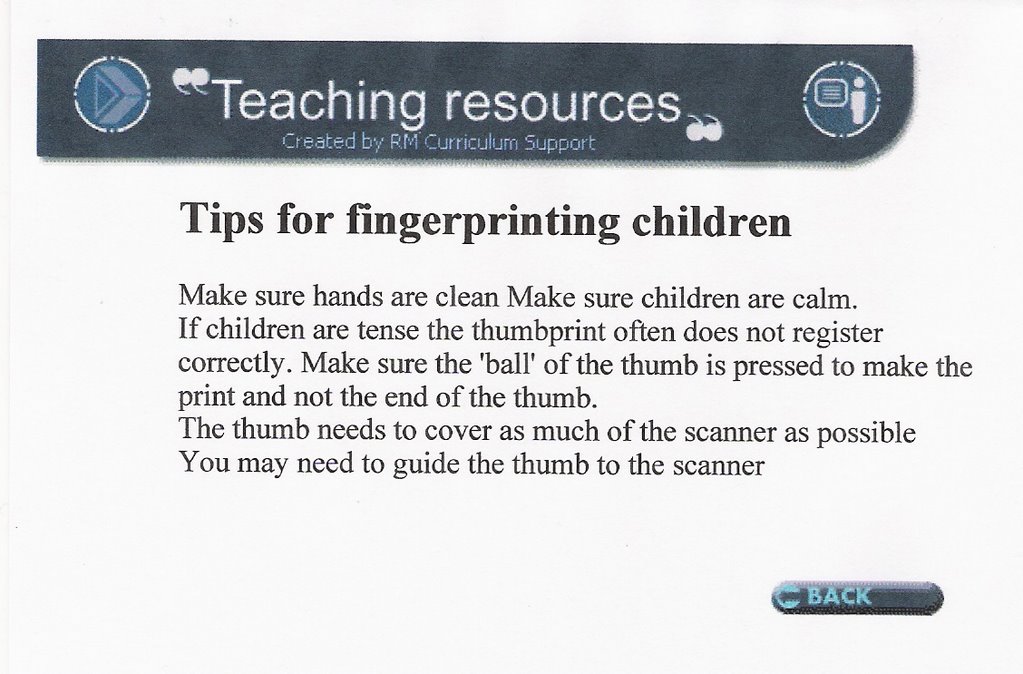
"Tips for fingerprinting children"

This has to be seen to be believed. This page was online from November 2001 until September 14th 2006 when all trace of it suddenly disappeared, less than 12 hours after Leave Them Kids Alone website brought it to public attention. LTKA's site details how the council have made no comment on this - what could they say! Thanks to the Internet Archive it is still available online.

I personally find the last sentance appalling.

"You may need to guide the thumb to the scanner" This 'advice' was on Dudley Council's website for nearly 5 years.

I find the mental image of a teacher physically guiding a childs hand to a fingerprint scanner very disturbing. What would the psychological effect of this have on a young child? It would be difficult to imagine a dissenting 16 year old's thumb being guided to a scanner. Older children are more aware of their rights and in some cases high school students have refused to have their biometrics used for access to books, lunches and computers. Younger children are not aware of their rights and are more bidable, is this where the above 'advice' is applicable?

Thank goodness Dudley Metropolitan Borough Council have withdrawn it, buts lets face it, it shouldn't have been there in the first place.

Surely this is advert enough to urgently review what exactly is happening in schools with biometric technology.

Sunday, November 12, 2006

Rolling it out in the States

There are more than 48 million school children in America, the implications for families, schools and business are huge over there - but where is the debate on this? Different states have different laws on biometrics in schools, some parents are asked for permission some are not asked for permission...

As schools are rolling this out in America, concerns are being voiced by parents, privacy groups and senators.

Rome NewsTribune, USA - “It may be perfectly secure, but my daughter is a minor and I understand that supposedly the kids have the option to not have their prints scanned but that’s not being articulated to my daughter,” said Hal Storey “If parents don’t know about it, they don’t know about the ‘opt out’ option.”

Storey’s issue is he was never notified or given information on the system before his 10th grade daughter’s finger was scanned.

ABC , USA - The Hope Elementary School District has
notified parents that, beginning this month, students at Monte Vista, Vieja Valley and Hope elementary schools will press an index finger to a scanner before buying cafeteria food.

"It raises sanitary issues, privacy issues, it is kind of Orwellian,"
said Tina Dabby, a parent of two at Monte Vista Elementary. "It just sounds kind of creepy."

CBN , USA- Chris and Joy Van Guilder recently moved to
Earlville, Illinois with their four children. Chris is opposed to biometrics.

Chris said, "Just red flags all over. I could just feel it
inside me--something is not right...We know this technology can be abused and used for controlling reasons."

Illinois State Senator Miguel Del Valle took action after learning of the Van Guilder's situation. His biometric bill requires parental permission, opt-out policies, and the protection of childrens' data. Del Valle said, "Lists are sold of personal information and so we want to make sure that that doesn't happen with children."

In the UK too:

icLiverpool, UK - Councillor Paul Clein, executive member for education, said:

"I do have misgivings about it and it is something that parents should have to actively agree to... any attempt by schools to force children to take part is wrong, and I would be very concerned if it became part of entry criteria, for example...I suppose it is a reflection of the times we live in, but I do not know where we draw the line."


MorecombeToday, UK - County Councillor Chris Coates, who represents Lancaster Central, said it was "too much of a Big Brother sledgehammer...what I'm really concerned about is that there has been no debate on this issue," he said"It seems to have been introduced without any consultation and real thought over the implications debate...The first I heard about it was when I was approached by a parent over the summer and I'm sure there are many people that don't know their children are being fingerprinted...It is such a big issue that we need a full debate to see if it's a road that we really want to go down."

Oxford Mail, UK - City Councillor Claire Kent found out about the system from her children, who attend the school.

She said: "They were told the data is not being shared with anyone else - but I don't believe that...It is something I would have liked to have been consulted on. What are they doing with the information? I'm very anxious that it doesn't get abused."

The Register, UK - A spokeswoman for the National Union of Teachers said: "Fingerprinting has to be done in consultation with parents and teachers and not imposed. By consultation, we are talking about proper consultation, giving parents time to respond, not installing the machines and then asking parents,"


Plus, there are concerns and issues raised by privacy groups here and in the States.

Biometrics in schools possibly makes queuing, paying for food/school trips a quicker process, registration less time consuming for the teacher, library book issue more streamlined but apart from the civil liberties concerns and worries over what will happen to the data stored now in the decades to come - it also removes the personal human element from school, a 'hello' from the school librarian or dinner lady and that important initial contact in school registration between teacher pupil.

Why are we road testing this technology on our children? Biometrics in schools doesn’t benefit children - biometrics benefits the data collectors not the data subjects/givers.