Showing posts with label Biometrics in schools. Show all posts

Tuesday, October 11, 2022

Facial Action Coding System (FACS) assessing emotions - is this a biometric?

When is facial recognition not facial recognition?  And when a school uses a facial action coding system (FACS) to analyse, in real time, a class of children's muscle movements from their face and body, not using a child's image, is this classed as biometric data processing?  This is a question I shall be asking the Information Commissioner's Office (ICO).  

Just to note, a child's fingerprint is not stored as an image but an algorithm - classed as a biometric, when processed in a school setting.

From a lay persons point of view, for the FACS to work it would have to first recognise that there are faces in front of the lens to process - hence facial recognition, therefore a biometric.  But as the system is not using the biometric to identify a specific human can we say that the school is processing an individuals biometric?  I would say yes, because without the collective children or individual child in front of the lens FACS would not work.  FACS can only work with biometric analysis.  Bio 'life' metric 'measure'.

FACS are employed in the Sens equipment being used in Smestow Academy.  Confirmed by the supplier ViewSonic's tweet.


The last couple of sentences of the second tweet is interesting:

"...we are in the early days yet.  Machine learning models take time to evolve."

Are the kids at Smestow Academy helping a FAC system "evolve"?  Is that ethical?  Do the parents and kids know they are helping to "evolve" a private company's commercial product, using the children's biometric muscle movements? 
-----------------------
How a Facial Action Coding System concludes - happiness, sadness, surprise, fear, anger, disgust, contempt.  

FACS potentially looks at lip, brow, nose, chin, neck data, nostril, jaw data whether muscles are tight or loose, head and eye movement, eyes blinking open shut, how much of the face is visible, shoulder shrug, sniffing and whether or not a smile is genuine... a lot of data.  

Here is the FACS inventors description of the technology:

Monday, October 10, 2022

UK schools using classroom biometric technology, data-scraping students faces to detect emotional engagement in lessons

I am writing this in frustration.  There is a video doing the rounds on Facebook and Twitter about schools in China using facial recognition to determine children's attentiveness in class.  It is understandably shocking to see this type of biometric facial/body scanning technology being used on children and the comments relating to the videos relay this.  

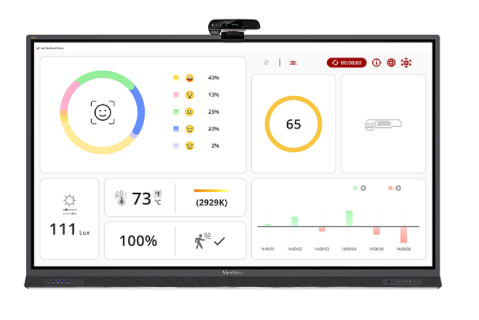
Little known is the fact we have the very same biometric technology operating here in UK schools, using biometric facial and body recognition data capture of students to generate 'mood indexing' information relayed in real time to the teacher in the class and school leaders.  It is called Sens and it is supplied by ViewSonic.  ViewSonic's Sens uses Intel's 'OpenVINO toolkit'. 


"To improve engagement rates, Sens measures every student’s facial expression for real-time tracking.  

Track reaction in real-time. From the front row all the way to the back of the room, dual lenses collect data from a full view of the classroom."


Sens biometrically captures a child's 5 emotions:  Happy / Sad / Upset / Amazed / Attentive and dutifully sends the teacher a real time alert to their phone to tell them how the lesson is going.  Placed on top of the white screen the lens silently acquires the breadth and depth of the classroom's human participants emotions.

(Above images from ViewSonic UK Youtube video detailing their collaboration with the City of Glasgow College)

How have we got to this type of technology being used in UK schools?  Simple - through a complete lackadaisical attitude from the UK Department of Education and an Information Commissioner's Office that is, and has been, devoid of regulating children's use of biometrics in schools over the past 2 decades.

The lack of due diligence displayed by these two institutions has enabled the use of biometric technology in schools to step over the boundary of services - using a face to buy a bag of chips, a fingerprint to access a library book - into the classroom to monitor students emotions.  Chinese style.

Okay, we have the consent in the Protection of Freedoms Act, the only legal right children have in schools to say no to their data sharing, but this is not well known and parents and students lack the knowledge of this IMHO, which is a shame because now we have sleepwalked into this situation where pupils emotions are being logged via biometric technology.

Biometric data is the most sensitive and irreplaceable data a child will ever own.  Why are schools using this data to see how students are engaging in a lesson?   

If a teacher cannot humanly know how their class is responding to their delivery of a lesson, either they are in the wrong job or maybe use the money spent on 'mood indexing' children to create smaller class sizes so teachers can 'get' how the lesson is going?

If 'mood indexing' biometric technology is accepted in UK primary and secondary schools by the Department of Education and ICO - then let's lead by example!  The next deployment of this surveillance technology surely should be installed in the House of Commons and Lords... live real time emotional engagement of our elected representatives.  Fantastic!

------------------------------

Smestow Academy, Wolverhampton - Youtube Hybrid learning at the academy, Freedom of Information request, written question asked in the House of Lords (Sept 2022) by Lord Scriven.  ViewSonic's case scenario.

City of Glasgow College - Youtube, Freedom of Information request, ViewSonic's case scenario 

There are another 3 schools, primary and secondary, in the UK that may be using Sens.  More on this to follow.


Thursday, August 18, 2022

Facial recognition in UK schools - the 'right' or 'wrong' type of biometric to be used with children?

10 months after the suspension of facial recognition (FR) at all the secondary schools in North Ayrshire Council, the Information Commisisoner's Office (ICO) has not yet issued any opinion on the use of FR in schools but are expected to publish this on their website in the near future (from their response to a Freedom of Information request received August 2022).  


The very much sooner the ICO issues their opinion the better.  We are seeing biometric analysis of children's bodily and facial data taken in schools, move from services, such as canteen and library, to classrooms monitoring emotional engagement.


A brief history of facial recognition in UK schools:

2010

Facial recognition was first used in UK schools.  Schools from Northamptonshire, Hertfordshire and Cambridgeshire used FR from September 2010 for registration.  The FR system was ‘faceREGISTER’ supplied by Aurora Computer Services, now part of Causeway.


Enquiries to the then Sir Christopher Hatton School, a comprehensive in Wellingborough, Northamptonshire, (now an academy) revealed that the system was scrapped after a few terms.


Since this instance, FR was not used in UK schools until 2020.


2020

FR was trialled in the summer term of 2020 at Kingsmeadow Community College for canteen payments.  It was fully implemented in the Autumn term of that year. 


The FR uses the School Information Management System (SIMS) photograph as a template.
The students present their face at a scanner at the point of sale (POS) to pay for their food.

The school is part of a pilot scheme and no funds were spent on the FR system.

If students do not wish to participate the person at the POS can identify the child by their photograph.

More information here.


FR supplied by CRB Cunninghams.


2021

CRB Cunninghams are supplying around 70 schools with FR technology.


In October North Ayrshire Council (NAC) implemented FR from CRB Cunninghams into 9 of its secondary schools.  The technology last a week.  It was suspended due to concerns from civil liberties groups and and parents.  The ICO paused the technology to review its acceptability under Data Protection Act 2018 and GDPR.


West Lothian Council (WLC) were planning on implementing FR in their 11 secondary schools.  In a January 2022 response to a Freedom of Information request they state, “WLC had begun to consider cashless catering in secondary schools using facial recognition, but this has not been progressed


It was unclear by the end of 2021 how many of the nearly 70 schools had gone ahead with their FR technology.  David Swanston, managing director of CRB Cunninghams stated, “some schools had shown concerns about the system as a result of the reporting on the North Ayrshire schools and the company is planning on issuing a statement to reassure them next week.”  That statement to schools, as far as is known, never appeared on CRB Cunninghams website.


2022

March PRNewswire reported that Smestow Academy, in Wolverhampton, are using a brand new type of facial/bodily scanning of students to determine their wellbeing in the classroom… “the first school in the UK to deploy the AI-powered myViewBoard Sens analysis tool in the classroom.” supplied by ViewSonic.

Through the real-time insights generated by the intelligent sensor, the school can ensure the classroom follows the wellness compliance, increase students' engagement, and facilitate a safe and active learning environment for the best possible learning outcome.


Smestow Academy are working with Intel and ViewSonic to develop “experimental hybrid learning rooms” within the academy - see 1 minute 59 seconds in this video - creating a "software ecosystem" to "add facial-expression recognition and mood indexing to better respond to learners' needs based on non-verbal cues"


April - Biometric Update reported that Stonyhurst College would be implementing FR in 2023 which “will have mobile and facial recognition with two-factor authentication to minimise occurrences of students and staff copying PINs” for door access.  The FR entry system is supplied by Suprema.  A case study video from Suprema ID showcases the company’s 50 biometric and mobile security reader devices in use at Stonyhurst College.


Suprema also provide Wolverhampton Grammar School with FR door access with an additional feature to read the body’s temperature.


June - A parliamentary House of Lords debate on Biometrics Technologies on the use of FR in schools.  Lord Scriven asks:

Facial recognition technology is now used in classrooms to monitor children’s mood and engagement, despite some parents objecting. The biometric regulator has no powers to enforce compliance with the law in schools and the department does not even monitor the use of this technology. Why are the Government taking this approach, allowing private companies’ marketing departments to determine the parameters of our children’s civil liberties and privacy in the classroom?


July - the Department for Education (DfE) issued new guidance on the use of biometric technologies in schools, with notable changes to include FR.  Seemingly some types of FR are acceptable:


Schools and colleges must establish that facial recognition is both necessary and proportionate within the school and college environment.”... with no explanation from the DfE how FR could be necessary or proportionate in schools.


Live facial recognition is not appropriate in schools or colleges.” (A tiddybiddy round of applause here I suppose).  It appears the the DfE is deciding which biometrics are acceptable for use on children in schools when legislations, such as the Data Protection Act 2018 and GDPR, do not offer parameters of acceptable levels.  


Other data regulators in the EU, under GDPR, have halted the use of FR and fingerprints scanners in schools, with fines issued to schools using biometric technology in Sweden, France, Bulgaria and Poland.


August - CRB Cunninghams removed a webinar, detailing the learning capabilities of the FR system they are supplying to schools, from their website and Vimeo.  In the spirit of transparency for students and parents to make an informed decision on consent as to whether they participate in this FR technology, this is how students facial biometric data is used and processed - the webinar exists here:


"the idea with the third template is that this will be updated every 3 months" 17mins 1s
"the algorithm grows with the child" 17mins 20s
"the system will match that for you by constantly evolving the algorithm to match the child's growth and change of appearance" 17mins 49s


----------------------------------------------------------


Our data regulator, the ICO, has yet to publish their opinion on schools processing students facial biometric data - or body movements to give emotional data to school leaders and Intel (if they even know about this?)


Though I’m not sure how an opinion can be had on the use of biometric technology in schools when legislations explicitly detail how this technology should not be used with children when other less data intrusive systems will suffice -  and less data intrusive systems do exist in a lot of UK schools... PINs, swipe cards, etc.  And especially when other equivalent EU data regulators follow those legislations and do not hold opinions on the 'right or wrong biometrics' to be used with children.

Wednesday, May 11, 2022

State of Biometrics 2022 - a review of policy and practice in UK education


I co-authored a report with Jen Persson from DefendDigitalMe, 'The State of Biometrics 2022 - a review of policy and practice in UK education', which was published last week.  There is no collection, monitoring, record of biometric technology in schools held by any UK government department, regulator or commissioner so information in the report was obtained by Freedom of Information requests and research collated over the number of years I've been doing this blog.

There is definitely further research and questions to be answers and issues to be resolved following the publication.  

Biometric technology has crept from school services, canteen, library, etc, into the classroom - where 'sensors' (cameras) now scrape data from children into a group view for teachers and management to gauge real time interest in lessons, engagement, attentiveness and emotion.  This behavioural data capture is classed as biometric data under the Protection of Freedoms Act, Chapter 2 (28)(2).

From PRNewswire:

"ViewSonic Corp., a leading global provider of visual solutions, has partnered with the Smestow Academy in Wolverhampton, England, as the first school in the UK to deploy the AI-powered myViewBoard Sens analysis tool in the classroom. Through the real-time insights generated by the intelligent sensor, the school can ensure the classroom follows the wellness compliance, increase students' engagement, and facilitate a safe and active learning environment for the best possible learning outcome."


The Report in summary

The Protection of Freedoms Act 2012 and weak enforcement of data protection law are failing to protect millions of children from the normalisation of routine use of biometric data for everyday canteen and library transactions, and increasingly intrusive bodily surveillance in the classroom. 


Pupils in the UK are effectively guinea pigs in the use of emerging technology for companies from around the world, including facial recognition technology that has already been banned from schools in other countries.


Some companies claim that their products can measure mood and attentiveness, or use artificial intelligence to manage behaviour-based classroom planning. Some companies even claim to be able to detect autism without any child development expertise.


How this normalisation and these emerging products may affect the full and free development of the child are yet to be seen.


The fast-growing uses of intrusive technology involving bodily data in educational settings worry child rights advocates and law makers alike. 


Lord Paul Scriven said, “As parents you should be very worried and angry that private companies are seeking to make a profit from your child’s face, fingers, eyes and other personal characteristics while trying to pretend that it is all to aid their educational attainment. Where do we draw the line?”


  • Data from FOI requests to schools (all UK) Our findings from enquiries to 550 schools with over a quarter of a million pupils in total, suggests that around three quarters of secondary schools are using fingerprint technology or other biometrics, and where used, uptake is routinely 85%, or more where use is restricted to only certain year groups.
  • Despite the law requiring consent some schools in England are discriminating against children in receipt of Free School Meals (FSM) by obliging them to use the fingerprint systems, and others make it obligatory for all pupils. (We are yet to quantify these issues and plan to continue further research.)
  • Emerging technologies, school trials and scope creep including under COVID. Schools started using facial recognition more widely in 2020. At least one school got new facial recognition technology free, “as part of a trial”. Some schools combined entry access readers with thermal and facial detection. Some are trialling “experimental” products including attentiveness and mood detection that are unevidenced in their intended outcomes or in any unintentional effects on children’s behavioural and cognitive development in UK classrooms. Voice is rarely considered under school biometrics policies whereas fingerprint technology is now routine.
  • Lack of regulatory enforcement. Six months after North Ayrshire schools in Scotland put their facial recognition rollout on pause, there has been no visible ICO regulatory enforcement action. We include a latest position statement in the report.
  • Large multinational companies have bought out the originally small school biometrics suppliers and many significant UK school providers are owned in the US, Canada and Israel.
  • Parents’ survey findings (2018) Survation polled 1,004 parents with children in state schools on behalf of defenddigitalme about their experience of technology in schools. Over a third of parents (38%) whose children were using biometrics in school, said they had not been offered any choice despite the law that requires parental consent, the Protection of Freedoms Act 2012, and over 50% of parents had not been informed how long their child’s  fingerprints or other biometric data is retained or when the data would be destroyed.


Professor Fraser Sampson, Commissioner for the Retention and Use of Biometric Material and Surveillance Camera Commissioner and author of the report foreword, suggests there is inadequate oversight of school procurement among wide ranging comments.  “Some – including, surprisingly, the Department for Education – appear to have taken the view that bare compliance with Chapter 2 of the Act is all that is required to ensure the lawful, ethical and accountable use of biometric surveillance in schools.” He asks five key questions of practice in schools: Who's benefiting? Who's watching? Whose company are you keeping? Where's the push? And, Why the rush?


There are no UK national requirements for any quality or health and safety standards of biometric or AI technology when used by state schools, and no oversight or record of what is used where.


Current legislation is ineffective in protecting children’s and students’ rights in educational settings from age 2-25 and change is needed now. defend digital me is calling for a ban on biometric systems in educational settings.


Authors: Pippa King and Jen Persson

Artwork: Hannah Mallory


Friday, October 02, 2020

Increase with online learning may need student's biometric data

With the increase of online learning the importance of verifying which student is sat in front of the screen, completing work, becomes a salient issue.  

Scotland have issued iPads to over 100,000 students and there is no authentic way of assuring who is doing the work on the iPad.  Whilst I am no fan of the use of biometrics with children this issue needs to be thought upon carefully as biometric tech could be considered to solve this conundrum.   

It will also be interesting to see attainment results with the use of iPads.  No doubt they will go up and this will be attributed to the success of 'educational iPad use' rather than kids finding ways to complete homework they find hard by getting others to do it.

Responses from councils in Scotland when asked under Freedom of Information about the how the authenticity of work, submitted via iPads, was checked were:

Teachers know the level to which their pupils are working and will discuss with their students if they have any doubt.

Teachers use their professional judgement to scrutinise all work undertaken by students, whether submitted electronically or on paper.

Pupils are encouraged to work collaboratively, learning from each other whilst understanding the consequences of plagiarism or submitting work which does not demonstrate their learning.  This is all part of pupils understanding their responsibility as a digital citizen.  We would also add that this is no different from other homework assignments.

The obvious glaring fact is that homework submitted on paper is far easier to spot authenticity rather than that of homework submitted electronically.  I, and everyone of my generation, knows how hard it was to offer in homework done by someone else in the good old days of pen and paper homework submission.

But electronic learning has been around for a fair few years and with the current global health situation the advent of online learning, electronic work submission and the increase of screen use for education is truly upon us and the digital age of education seems to be working.  

However, along with that, as one of the responses states above, pupils need to understand their responsibility as a "digital citizen" - fair enough.  But does the Ed Tech industry and the Department of Education understand their responsibility as digital caretakers of the next generations digitised data, collected through the ever increasing online learning epidemic?  I think a long hard stare at this is necessary.  

Over on Defenddigitalme's website there are numerous instances of digital deep dives into not just children's educational prowess but how and what they are using their computer for.  Flagged words, conversations had, search terms scrutinised, incorrect data logged against students, flawed analysis of work done - the latter being blindingly obvious with the inaccurate 'exam' results for student in July last year, affecting the university places and the potential career paths of thousands of students.

So whilst electronic learning will not take a step backwards, indeed it looks like increasing, there are many reasons why we must tread carefully into this new educational online world.  Responsibility must be had by both parents, being vigilant of what data educational apps siphon, and the learning community/industry driving this screen-learning environment forward.

Many studies, too numerous to list here but easily found online, are showing that too much screen time for young brains is not good. One Harvard paper states:

"Much of what happens on screen provides “impoverished” stimulation of the developing brain compared to reality"

And this from the USA National Institutes for Health:

"Early data from a landmark National Institutes of Health (NIH) study that began in 2018 indicates that children who spent more than two hours a day on screen-time activities scored lower on language and thinking tests, and some children with more than seven hours a day of screen time experienced thinning of the brain’s cortex, the area of the brain related to critical thinking and reasoning."

It is no wonder then that tech giant's children have very limited screen time and are sent to schools that do not use screens to educate with.

However, for the vast majority of children, screens will be used and with that will come the data mining that goes along with it.  And, I suspect, it will only be a matter of time before biometrics are used to verify who is at the device.

A desensitisation of the use of biometric data has happened over the past 2 decades with police forces (in the UK and abroad) widely using facial recognition, unwittingly on the population, without any parliamentary oversight, arguably tip toeing the line between whether the use is lawful or not.

However, in 2015 biometric facial scanning was introduced every 60 seconds to iPad learning in San Diego schools but a backlash on the grounds of privacy intrusion from parents scuppered the scheme.  Whether that backlash would happen again in this day and age remains to be seen.

Monday, July 06, 2020

Biometric fingerprint readers ditched for hygiene reasons... to be replaced by contactless biometric systems?

On Twitter schools have been spotted ditching biometric fingerprint readers for contactless cards due to hygiene reasons, which completely makes sense as this was one of the issues raised initially over 15 years ago when fingerprint scanners started appearing in schools.  

Though some biometric suppliers have been keen to stress that sterilising fingers before using biometric scanners is good to keep children 'safe'.


So as good as it is to see fingerprint scanners be replaced by less personally intrusive methods it does open the way for a contactless biometric system, i.e. facial recognition, to replace the touch fingerprint pad.

Which seems to be, somewhat, what has happened here at a UTC school in Leeds, UK, where Years 10 (14/15 year old) and Year 12 (17/18 years old) students have started school after having been shut since mid March 2020.  

A combined facial recognition and thermal imaging system has been installed to check student's temperature to identify each student whose temperature is taken.  However it has to be said they have ditched their fingerprint scanners for contactless cards, which was used for building entry, class registration and lunch payment.  The newly installed facial recognition has not directly replaced, on first glances, the fingerprint system but it is still registering the students with their biometric data.

We have also installed a high spec thermal camera in the reception area. This camera uses facial recognition technology to enable unobtrusive thermal imaging and temperature measurements of students and staff. An alert is issued to the Principal if someone’s temperature is above a certain level.

Every school in England and Wales that wishes to process an under 18 year old's biometric data, including facial recognition, needs explicit written parental consent to do so and it is uncertain whether this particular UTC has done that.  When questioned specifically on whether they had gained parental consent, as per the Protection of Freedoms Act 2012, the UTC replied:


Albeit it this is a reply on Twitter (which now looks to be unavailable) but it is not glaringly obvious that the school is operating this biometric system in line with UK legislation specifically aimed at schools processing children's biometric data - The Protection of Freedoms Act 2012.  

The use of facial recognition in UK schools is also questionable under GDPR, the EU General Data Protection Regulations 2018.  Schools in France have been advised not to use facial recognition and a school in Sweden was fined for using the technology.  GDPR does not change at country borders or whether we are Brexiting so the use of facial recognition technology is certainly questionable in this UK school.

There are good reasons legislations are specifically put in place to protect children biometric data being unnecessarily processed and they should be adhered to.  


Monday, March 09, 2020

Fine for processing students’ fingerprints imposed on a school

Photo
A statement, issuing a fine, to a school from Poland’s Personal Data Protection Office (UODO), the equivalent to our Information Commissioner's Office (ICO), found the school to be in breach of the General Data Protection Regulations (GDPR) for using children's fingerprint data to allow access to their canteen.  The ruling stated that:

"The school processed special categories of data (biometric data) of 680 children without a legal basis, whereas in fact it could use other forms of students identification."

and
"...it is important to stress that the processing of biometric data is not essential for achieving the goal of identifying a child’s entitlement to receive lunch. The school may carry out the identification by other means that do not interfere so much in the child’s privacy. Moreover, the school makes it possible to use the services of the school canteen not only by means of fingerprints verification, but also electronic cards, or by giving the name and contract number. Thus, in the school, there are alternative forms of identification of the child’s entitlement to receive lunch."
Here in the UK biometric fingerprint readers have been used in schools since 1999.  Up to 2012 schools were using children's fingerprints quite often without informing parents or asking their permission, as a consequence after some pressure upon the UK Government to address this, legislation was passed in 2012 requiring schools to obtain parental permission to process their child's biometric data and offer an alternative means to the biometric system. 


However, a survey done by children's data privicacy group defenddigitalme found that even after the 2012 legislation parents were still unaware of options not to use the fingerprint system.

Children's biometric data needs to be secure for the child's lifetime - decades.  It does seem excessive to use biometric data for daily mundane tasks in school, when another form of ID is perfectly acceptable - we have expressed that view since 2005.

This point was also expressed in the UODO report according to Venturebeat:

'The final decision cited numerous facets of GDPR, including recital 38, which refers to specific provisions made for data protection of children, "it should be emphasised that children require special protection of personal data, as they may be less aware of the risks, consequences, safeguards, and rights they have in connection with the processing of personal data" the report found.'

If the Polish Data Protection Office have ruled this use of children's fingerprint biometrics as a violation of GDPR then presumably the same would apply to any school using such systems in the UK.

This is absolutely a GDPR issue we will be following up here in the UK.

The English text of the UODO decision is here and the Polish version here.

Tuesday, July 09, 2019

Biometric Consent for Scottish children in schools

The Protection of Freedoms Act 2012,  Chapter 2 Protection of biometric information of children in schools etc. deals with consent required when schools process children's biometric data.  Unfortunately this part of the Act only applies to schools in England and Wales.  A Freedom of Information request sent to the Home Office clarifies this.

In order to help extend this consensual right to children in Scotland and Northern Ireland Freedom of Information requests were sent, in August 2018, to all 32 Local Government authorities in Scotland to ascertain how many schools were using biometric technology. 

Here are the results of the Freedoms of Information Request as of Early 2019:


There are plans in Scotland to introduce a Biometrics Commissioner 2019/2020 whose remit will only cover the justice sector in the country in the collection and processing of biometrics - Police Scotland and the Scottish Police Authority.

With the widening use of biometrics, especially the historic and current use in schools, concerns about the limiting scope of the forthcoming Scottish Biometrics Commissioner's role may be aired in the Scottish Parliament.

Any developments concerning this will be posted here.

Thursday, November 08, 2018

'Who knows what about me?'

The publication of the "Who knows what about me?" report today by the office of The Children's Commissioner for England highlights the huge amount of data gathered on children, including the use of biometric technology in schools.

5 salient points about biometric technology used in schools is listed in the infographic in this post.

Using one's biometric data is a more data intrusive way of accessing schools services than a PIN or swipe card.  This has been recognised by legislation and schools therefore are legally obliged to offer students an alternative means to access such services and must have consent, from both parents and students, if biometric data is to be taken and processed.

Schools in the UK have been using biometrics since 1999.   Often this was done without informing parents due to the fact that the Data Protection Act 1998 did not list biometrics as 'sensitive' personal information, hence parents permission or even knowledge that their children's biometric were being taken happened.

Many different types of biometric technology have been used in schools. The biometric most used is fingerprint.

Campaigning by parents lobbying Members of Parliament culminated, 13 years after schools started using the technology, with legislation covering consent to biometric processing in the Protection of Freedoms Act 2012, Chapter 2.

It is prudent to minimise personal data given.  We have no idea if a child's biometrics given in the education system is compromised or shared, with other agencies or companies, the effect this may have later in their life.

Know your facts and consider keeping your child's biometric digital data from unnecessary use when an alternative means of identification will suffice.

Saturday, September 29, 2018

Scottish schools Freedom of Information results so far...

This is an update on the Freedom of Information requests (FOIR) sent to all 32 Scottish local authorities in August to determine the use of biometrics in schools there.  This is with a view to extending the same rights that English and Welsh children have not to have their biometrics collected and processed in schools, with an entitlement to use an alternative way of accessing school services such a a PIN or swipe card.

Some interesting results have turned up in the two thirds of FOIRs that have been received back so far.  There seems to be two companies supplying the Scottish market with one most dominant.  The company that is most dominant also introduced the biometric fingerprint scanners in schools as early as 1999 and 2000.

This is a surprise to me as I was under the impression that schools in the UK started the introduction of fingerprint scanners for libraries in 2001when the below communications with a school biometric supplier, the Information Commissioner's Office (ICO), who oversees the Data Protection Act, and Department for Education (DfE) took place.  See bottom of this post.  So it would be interesting to see if the ICO and DfE knew about the earlier use of children using their biometrics and see any correspondence on that.

With the results from the FOIR so far it seems that currently around 5% of children in Scotland use their biometrics to access school systems, although I still have a third of the authorities yet to reply.  Even so this amounts to 35,000 plus children and that is only a snapshot of current usage.  Given that some authorities have been using biometrics in schools for nearly two decades, this significantly raises the amounts of children that have had their biometrics logged at schools in Scotland to the many tens of thousands, if not over the hundred thousand mark.  The current Scottish school population is just over 687,000 children.

When all of the Scottish authorities have responded I will post more here.


Thursday, August 30, 2018

Consent needed by schools to process biometric data

I do have other posts pending but as it is that time of year students start new schools I am re-posting this salient information, originally posted in May 2017.   Also see the UK Department for Education's 'Protection of biometric information of children in schools and colleges'

Schools obligations to students biometric data

It's that time of year again, when parents with children going up to high schools are encountering biometric systems in their children's new schools and are unsure of their rights to consent and what responsibilities the school has to ensure school services are not withheld from students who do not participate in their biometric system.  Hopefully this will clarify schools, parents and children's position.  A PDF version can be found here.

A school’s responsibility
A school cannot take and process a student’s, under 18 years old, biometric data without the consent of the parent/s or the student.  Consent must be given in writing from the parent/s.  Consent can be withdrawn at any time.


CONSENT
·         If one parent consents and the other does not, the non-consent takes precedence.

·         If the parent/s consent and the student does not, the students non-consent takes precedence.

·         If the parent/s do not consent and the student does consent, the parents non-consent takes precedence.

If a consent is not given the school “must ensure that reasonable alternative means are available by which the child may do, or be subject to, anything which the child would have been able to do, or be subject to, had the child’s biometric information been processed.” as detailed in the Protection of Freedoms Act 2012,Chapter 2 Section 26 (7).

Parents
Parent/s must be informed by the school that they are using a biometric system and the school must gain written consent from the parent/s to take and process their child’s biometric data.  You may withdraw your consent at any time.
Schools do not always make it clear when asking for consent that an alternative to the biometric system is available and that non-consent ultimately lies with the student.

Students
Regardless of consent given by your parent/s you alone determine whether a school takes and processes your biometric data.   If you choose not to use a biometric system the school must provide an alternative and must not withhold any services from you that is available through their biometric system.  You may withdraw your consent at any time.