10 months after the suspension of facial recognition (FR) at all the secondary schools in North Ayrshire Council, the Information Commisisoner's Office (ICO) has not yet issued any opinion on the use of FR in schools but are expected to publish this on their website in the near future (from their response to a Freedom of Information request received August 2022).
The very much sooner the ICO issues their opinion the better. We are seeing biometric analysis of children's bodily and facial data taken in schools, move from services, such as canteen and library, to classrooms monitoring emotional engagement.
A brief history of facial recognition in UK schools:
2010
Facial recognition was first used in UK schools. Schools from Northamptonshire, Hertfordshire and Cambridgeshire used FR from September 2010 for registration. The FR system was ‘faceREGISTER’ supplied by Aurora Computer Services, now part of Causeway.
Enquiries to the then Sir Christopher Hatton School, a comprehensive in Wellingborough, Northamptonshire, (now an academy) revealed that the system was scrapped after a few terms.
Since this instance, FR was not used in UK schools until 2020.
2020
FR was trialled in the summer term of 2020 at Kingsmeadow Community College for canteen payments. It was fully implemented in the Autumn term of that year.
The FR uses the School Information Management System (SIMS) photograph as a template.
The students present their face at a scanner at the point of sale (POS) to pay for their food.
The school is part of a pilot scheme and no funds were spent on the FR system.
If students do not wish to participate the person at the POS can identify the child by their photograph.
More information here.
FR supplied by CRB Cunninghams.
2021
CRB Cunninghams are supplying around 70 schools with FR technology.
In October North Ayrshire Council (NAC) implemented FR from CRB Cunninghams into 9 of its secondary schools. The technology last a week. It was suspended due to concerns from civil liberties groups and and parents. The ICO paused the technology to review its acceptability under Data Protection Act 2018 and GDPR.
West Lothian Council (WLC) were planning on implementing FR in their 11 secondary schools. In a January 2022 response to a Freedom of Information request they state, “WLC had begun to consider cashless catering in secondary schools using facial recognition, but this has not been progressed”
It was unclear by the end of 2021 how many of the nearly 70 schools had gone ahead with their FR technology. David Swanston, managing director of CRB Cunninghams stated, “some schools had shown concerns about the system as a result of the reporting on the North Ayrshire schools and the company is planning on issuing a statement to reassure them next week.” That statement to schools, as far as is known, never appeared on CRB Cunninghams website.
2022
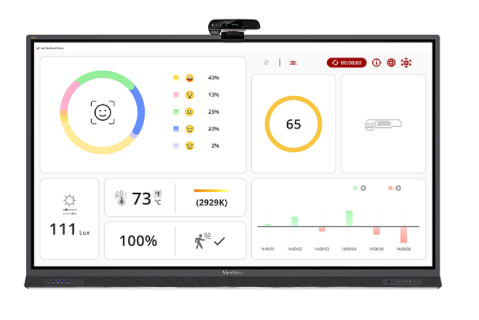
March - PRNewswire reported that Smestow Academy, in Wolverhampton, are using a brand new type of facial/bodily scanning of students to determine their wellbeing in the classroom… “the first school in the UK to deploy the AI-powered myViewBoard Sens analysis tool in the classroom.” supplied by ViewSonic.“Through the real-time insights generated by the intelligent sensor, the school can ensure the classroom follows the wellness compliance, increase students' engagement, and facilitate a safe and active learning environment for the best possible learning outcome.”
Smestow Academy are working with Intel and ViewSonic to develop “experimental hybrid learning rooms” within the academy - see 1 minute 59 seconds in this video - creating a "software ecosystem" to "add facial-expression recognition and mood indexing to better respond to learners' needs based on non-verbal cues"
April - Biometric Update reported that Stonyhurst College would be implementing FR in 2023 which “will have mobile and facial recognition with two-factor authentication to minimise occurrences of students and staff copying PINs” for door access. The FR entry system is supplied by Suprema. A case study video from Suprema ID showcases the company’s 50 biometric and mobile security reader devices in use at Stonyhurst College.
Suprema also provide Wolverhampton Grammar School with FR door access with an additional feature to read the body’s temperature.
June - A parliamentary House of Lords debate on Biometrics Technologies on the use of FR in schools. Lord Scriven asks:
“Facial recognition technology is now used in classrooms to monitor children’s mood and engagement, despite some parents objecting. The biometric regulator has no powers to enforce compliance with the law in schools and the department does not even monitor the use of this technology. Why are the Government taking this approach, allowing private companies’ marketing departments to determine the parameters of our children’s civil liberties and privacy in the classroom?”
July - the Department for Education (DfE) issued new guidance on the use of biometric technologies in schools, with notable changes to include FR. Seemingly some types of FR are acceptable:
“Schools and colleges must establish that facial recognition is both necessary and proportionate within the school and college environment.”... with no explanation from the DfE how FR could be necessary or proportionate in schools.
“Live facial recognition is not appropriate in schools or colleges.” (A tiddybiddy round of applause here I suppose). It appears the the DfE is deciding which biometrics are acceptable for use on children in schools when legislations, such as the Data Protection Act 2018 and GDPR, do not offer parameters of acceptable levels.
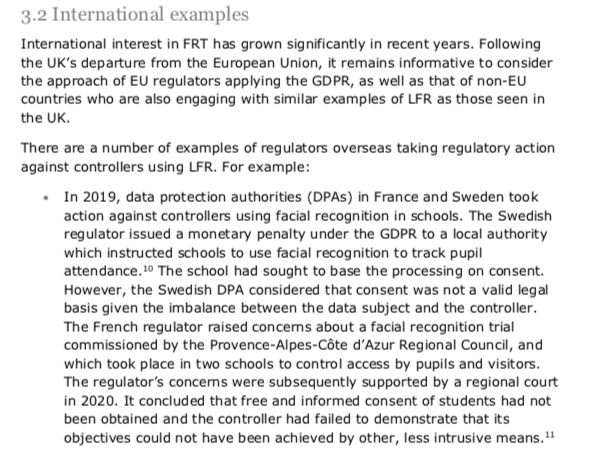
Other data regulators in the EU, under GDPR, have halted the use of FR and fingerprints scanners in schools, with fines issued to schools using biometric technology in Sweden, France, Bulgaria and Poland.
August - CRB Cunninghams removed a webinar, detailing the learning capabilities of the FR system they are supplying to schools, from their website and Vimeo. In the spirit of transparency for students and parents to make an informed decision on consent as to whether they participate in this FR technology, this is how students facial biometric data is used and processed - the webinar exists here:
"the idea with the third template is that this will be updated every 3 months" 17mins 1s
"the algorithm grows with the child" 17mins 20s
"the system will match that for you by constantly evolving the algorithm to match the child's growth and change of appearance" 17mins 49s
----------------------------------------------------------
Our data regulator, the ICO, has yet to publish their opinion on schools processing students facial biometric data - or body movements to give emotional data to school leaders and Intel (if they even know about this?)
Though I’m not sure how an opinion can be had on the use of biometric technology in schools when legislations explicitly detail how this technology should not be used with children when other less data intrusive systems will suffice - and less data intrusive systems do exist in a lot of UK schools... PINs, swipe cards, etc. And especially when other equivalent EU data regulators follow those legislations and do not hold opinions on the 'right or wrong biometrics' to be used with children.